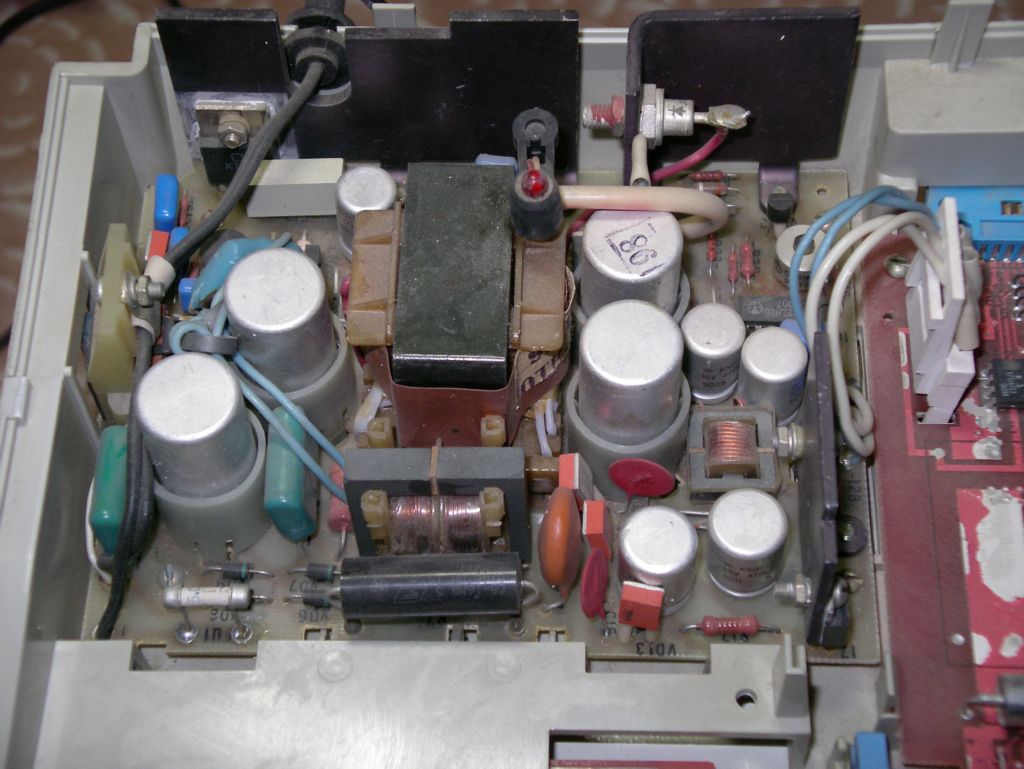
UKNCs were made in two voltage variants: 42 V AC models for classroom use and 220 V for the regular USSR mains. 42 V machines were made in bigger quantities and are now much more common.
Earlier machines, including mine, had a power supply equipped with a transformer from 220 or 42 V down to 20 V, followed by a switched-mode stage.
Later models had full voltage switched-mode PSUs, so their transformer was a lot smaller. They looked like this. Thus, there were four part numbers:
| Transformer + SMPS | SMPS | |
|---|---|---|
| 42 V | MS (МС) 9012.01 | MS (МС) 9022.01 |
| 220 V | MS (МС) 9012.02 | MS (МС) 9022.02 |
They were specified for 5 V DC output at 0.5 to 2.5 A. Some PSUs could also provide ±12 V at a low current for ‘Стык С2’, an RS-232 compatible serial port.
I was lucky enough to have acquired a 220 V AC model. If you’d ended up with a 42 V machine, you would have a few options as discussed here: Что делать с 42В блоком питания? (in Russian). Here’s what it says, with my comments.
MS 9012.02 in my 220 V machine apparently has the same electronics as the 9012.01, the sole difference being the transformer. To confirm, I also measured around 29 V past the rectifier – which is slightly higher than the Soviet spec due to the UK voltage. In practice, anything between 20 and 30 volts should work, but do check what your PSU is expecting there before injecting anything above 12 V into the circuit.
Out of abundance of caution, I used a current-limited power source to allow capacitors to reform if they wanted to. They seemed fine, though.
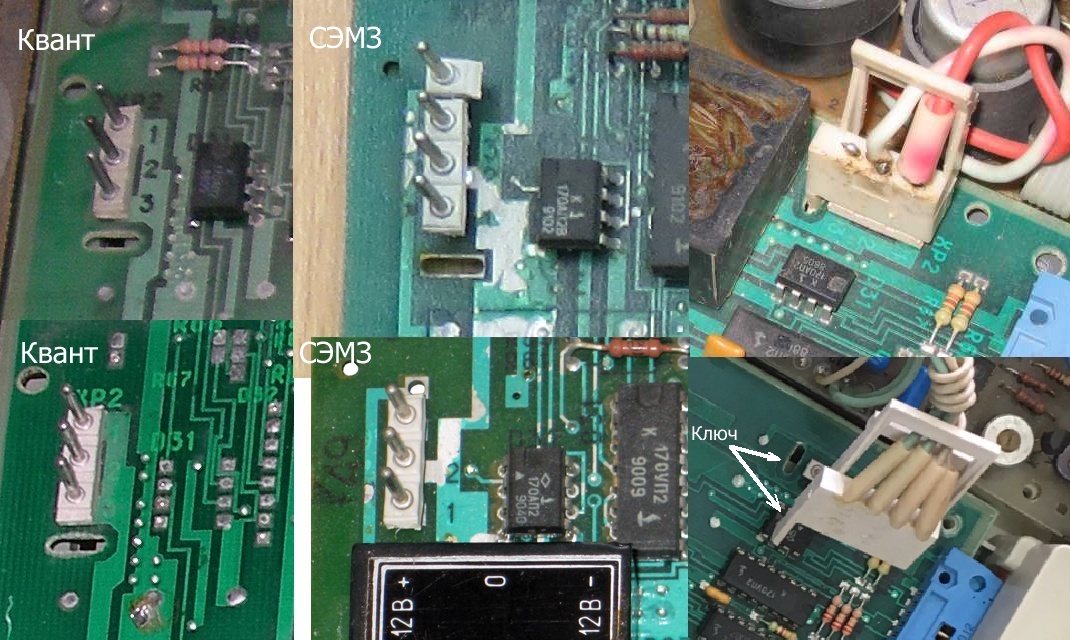
For reasons unknown, the power supply and the main board in my machine came from different manufacturers. The PSU was made by Kvant in Zelenograd, and the board by SEMZ in Solnechnogorsk, both near Moscow. The two factories used similar DC power connectors but with different pinouts:

I used wires to make the connection initially. The machine appeared to be working. There was video signal, the keys made clicky noise through the speaker, and the video waveforms changed in response to my keypresses.
I resoldered the Kvant PSU connector to match the SEMZ pinout and plugged it directly into the main board. When I switched it on again, a loud whine came out of the power supply, although everything else appeared normal. How odd. I pulled the connector out and put the wires back in. The whine disappeared.
I had a look at the 5 V rail ripple on the oscilloscope, having set it to AC coupled. With the wires in place between the connectors, the rail looked pretty normal with a decently small amount of ripple at about 25.4 kHz:

But when the PSU was plugged directly into the main board, the picture was different:

That’s a lot more ripple. And, although the PWM regulator was still running at 25.4 kHz, its switching had become irregular, so the fundamental frequency had dropped down to an ear-piercing 6.4 kHz. The PWM control signal was consistent with the ripple:

Was it the extra resistance or inductance of the wires inserted between the PSU and board connectors?.. I decided not to investigate this further, since the issue had effectively been resolved.